ADVERTISEMENT
Most people see “odd one out” quizzes as nothing more than quick entertainment while scrolling online, but the truth is that these tiny decisions often reveal something surprisingly interesting about the way our brains process the world. The animal that immediately catches your attention says less about the quiz itself and more about what your mind naturally prioritizes first — structure, emotion, logic, transformation, or hidden detail.
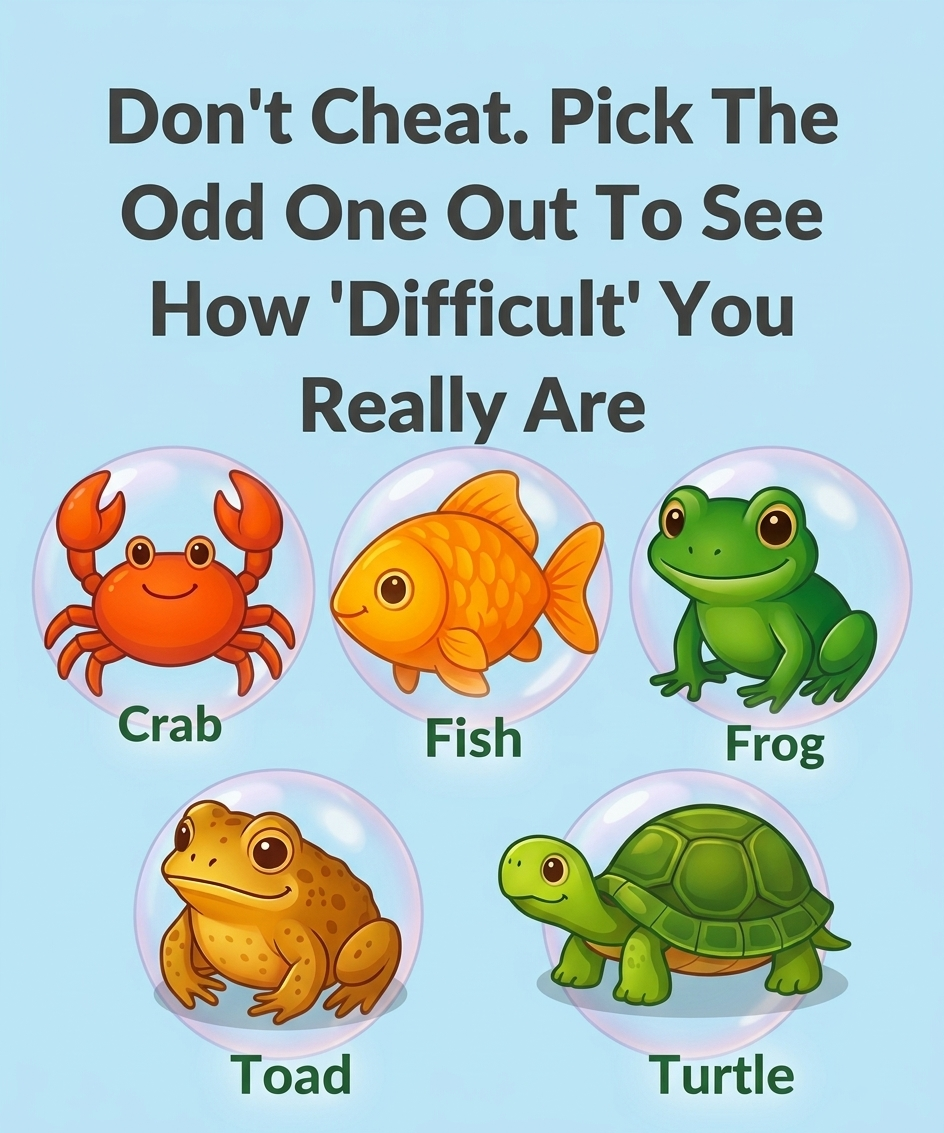
Imagine looking at a simple lineup containing a crab, fish, frog, toad, and turtle. At first glance, it seems obvious that one of them should stand apart from the rest, yet different people consistently choose different answers because perception is deeply personal. Some people instinctively focus on appearance, others notice habitat, while some immediately classify biological categories or patterns of change.

If the crab stood out to you first, your mind is likely wired toward structure and visual distinction. The crab differs dramatically from the others in body design, movement, and anatomy, which means your brain naturally notices physical inconsistencies before anything else. People with this thinking style tend to value organization, systems, and logical order, often becoming the person others rely on when situations feel chaotic or confusing. You probably prefer clear frameworks, practical solutions, and environments where things make sense.
If you immediately chose the fish, your thinking style is probably more contextual and relationship-focused. Unlike the other animals, the fish cannot survive on land, meaning your brain instinctively noticed the environmental connection rather than physical appearance. This usually reflects a big-picture mindset where you naturally think about how things interact instead of viewing them separately. People like this are often creative problem-solvers who see long-term consequences and understand how individual actions affect larger systems.
Choosing the frog often points toward a mind that focuses on growth and transformation. Frogs go through one of nature’s most dramatic developmental changes, beginning life as aquatic tadpoles before transforming into land-capable adults. If your attention went there first, you likely see life as a process rather than a fixed state. You may be especially sensitive to personal growth, emotional development, and the hidden potential inside people or situations. Others probably view you as emotionally intelligent, patient, and naturally supportive.
If the toad was your answer, your brain probably notices subtle distinctions that many people overlook. Most individuals casually group frogs and toads together, but your attention immediately zoomed in on the finer differences in texture, behavior, and appearance. This suggests a detail-oriented mindset where precision matters deeply to you. In conversations, projects, or social situations, you’re likely the person who notices inconsistencies, hidden signals, or important details everyone else misses.

Meanwhile, choosing the turtle often reflects a highly systematic and classification-based style of thinking. While the other animals belong to entirely different biological groups, the turtle stands out as the only reptile. If your brain focused on that distinction first, you likely approach life analytically, preferring logic, categories, and structured reasoning over instinct alone. People with this mindset are often dependable planners who solve difficult problems carefully and methodically rather than emotionally.
What makes exercises like this fascinating is that there is no universally correct answer. The point is not to measure intelligence or judge personality, but to highlight how differently human minds observe the exact same information. One person notices shapes first, another notices relationships, while someone else immediately sees transformation or hidden nuance.
And honestly, that difference in perception is part of what makes people interesting in the first place.
ADVERTISEMENT
