ADVERTISEMENT
That Saturday began exactly like that, with the kitchen filled by the familiar scent of bacon and cinnamon, the quiet rhythm of preparation unfolding without urgency, and the assumption—one I didn’t even realize I was making—that the day would continue in the same predictable way it always had.
The first sign that something had shifted came not as a clear event, but as a disruption, the back door slamming with enough force to rattle the utensils on the counter, followed by my daughter’s voice cutting through the space in a way that immediately erased any sense of normalcy.
When I turned around, what I saw did not register all at once.
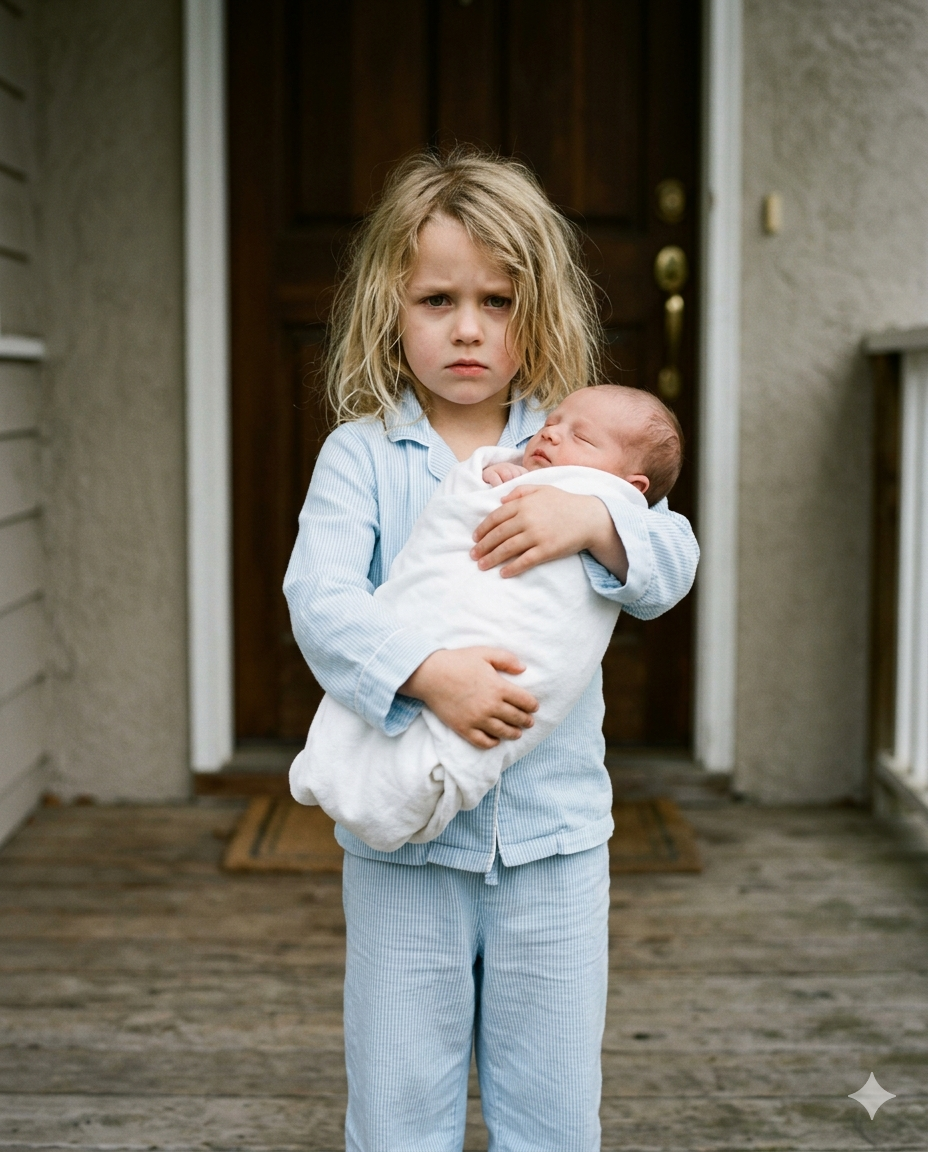
Bare feet, dirt on her toes, her small hands trembling so violently that water spilled from the can she had been holding, and in her other arm—
An infant.
Then he made a sound.
I moved instinctively, taking him from her with a care that felt almost mechanical, my hands already searching for warmth, for anything that could stabilize him, because there was no time to question where he had come from or how he had ended up there.
Not cold.
Freezing.

He appeared within seconds, and the moment he saw the baby, something in him changed in a way that was subtle but unmistakable. It wasn’t confusion, and it wasn’t shock. It was something closer to recognition, quickly suppressed but not completely hidden.
“Call 911,” he said.
Almost.
“I know who did it.”
The words settled into the room in a way that altered everything, not because of what they implied, but because of how she said them—quietly, without uncertainty, as though she were stating something she had already accepted as fact.
Ryan turned toward her immediately, his tone shifting into something softer, almost careful.
“This isn’t the time to guess,” he said.
She didn’t respond to the tone.
She responded to the truth.
“I saw,” she said.
And then she pointed at him.
There are moments when the body reacts before the mind can catch up, when understanding arrives not through thought, but through a physical shift that makes everything feel slightly off balance.
That was one of those moments.
Ryan laughed, but the sound didn’t hold, breaking apart too quickly to feel natural.
“That’s not funny,” he said.
She wasn’t smiling.
She explained what she had seen in simple, direct terms, describing waking up, hearing the door, looking through the glass, and watching him step outside carrying something wrapped, something she hadn’t understood until later, when she found the baby where he had left him.
The room seemed to narrow.
Not physically.
But in a way that made everything outside that moment irrelevant.

Ryan denied it immediately, his voice rising just enough to signal control rather than panic, framing her words as confusion, as fear, as a child misinterpreting something she didn’t understand.
And for a moment, his explanation almost worked.
Until I saw the note.
It was partially hidden within the blanket, folded in a way that suggested it had been placed deliberately, not dropped or forgotten, and when I pulled it free and unfolded it, the message was simple enough to be undeniable.
His name.
A child.
A promise broken.
The effect was immediate.
Not dramatic.
Not explosive.
Just clarity.
The version of him I had known for years, the one built on consistency and reason, began to fracture in ways that could not be reversed, revealing something underneath that I had never fully seen, or perhaps had never allowed myself to see.
When I told him to call the police, it was no longer a suggestion.
It was a decision.
The arrival of his mother complicated the moment, not because she didn’t understand what was happening, but because she understood too quickly, her reaction shifting from confusion to recognition in a way that confirmed what I had already begun to accept.
The explanations came in pieces.
First from him, then from the evidence, and finally from the reality that could no longer be avoided.
He had found the child earlier.
His child.
Left outside with a note that forced a truth he had been avoiding.
And instead of facing it, instead of telling me, instead of taking responsibility, he had moved the baby, repositioned the situation, and waited for it to unfold in a way that allowed him to remain separate from it.
He had relied on chance.
On our daughter.
That was the moment everything ended.
Not when I learned about the affair.
Not when I understood the deception.
But when I realized he had involved her.
At the hospital, the rest of the story revealed itself with a kind of quiet inevitability, the child’s mother explaining her desperation, her belief that forcing him to confront the situation would lead to something different, something honest.
She had been wrong.
And yet, in her exhaustion and fear, there was something real that I could not ignore, something that shifted the situation from anger into something more complicated.
Responsibility.
When I returned home, the house felt unfamiliar, not because anything had physically changed, but because the structure I had trusted no longer existed.
Ryan stood waiting.
His bag already packed.
There was nothing left to discuss.
No explanation that could alter what had already been done.
No apology that could reach the place where the damage had settled.
So I opened the door.
And told him to leave.
Not because I was angry.
Although I was.
But because some lines, once crossed, do not allow you to return to what came before.
And using our child to hide the truth was one of them.
ADVERTISEMENT
